The portal of the Umbria Region that allows you to get information on the main places of culture in Umbria (museums, archaeological sites, libraries ...)
The Museo Archeologico Statale di Spoleto is located in the former Monastery of Sant’Agata, in the historical city centre of Spoleto, in the southern block of houses formed by the crossing of the modern road of Via Monterone and Via Sant’Agata, where the ancient Roman Theater used to be.
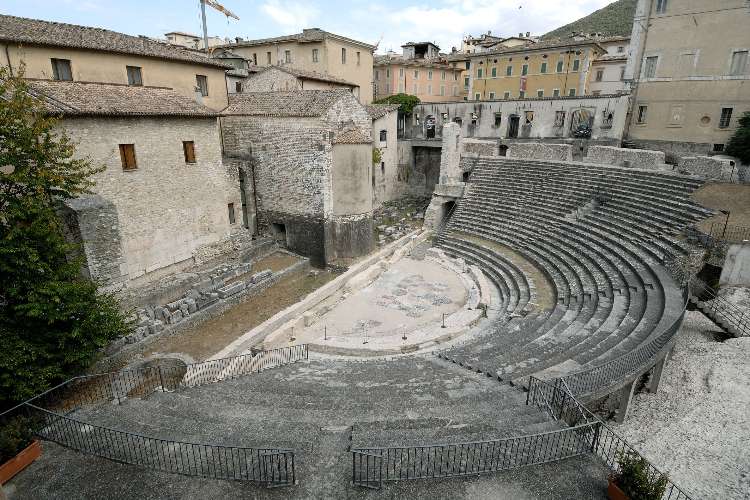
The religious edifice, once a Monastery dedicated to St Agatha, was built at the end of the 14th century over the remnants of a Roman Theatre—dated 1st century B.C.—dramatically changing the scenic setting.
Inaugurated in 1985, the museum stretches over several floors, adapting its display to the architecture of the historical edifice. A new design of organic renovation of the old display has been foreseen; and a first section, of this new future setting, was already completed in 2008.
Through the archaeological finds that also come from more recent research, the early human presence where the Rocca—medieval fortress—stands and in the area of the town historical center—dating from the Bronze Age and from the period when the Umbrian settlement developed—is documented. This is especially testified by the rich funerary goods, dating from the 7th and 6th century B.C., found in the Piazza d’Armi Necropolis.
The items found in Valnerina, an area that has always had a close relationship with Spoleto, are exhibited on the second floor of the museum. The late Bronze Age cinerary urns found in the Necropolis of Monteleone di Spoleto, the finds from Montefranco Sanctuary, and the funerary goods from the Hellenistic and Roman Necropolis of Norcia are particularly worth being mentioned. Also many finds from the Canzio Sapori Collection, recently donated to the State, come from this same territory. It is worthwhile mentioning a cinerary clay-pugged urn decorated with a geometrical pattern coming from Ponte di Cerreto and a notable Late Republican male bust from Ferentillo.
In the section dedicated to the illustration of the Roman Theater, decorative sculptures found at the excavation site inside the monument—discovered during the 1950s— are exhibited. These include The Aura—personification of a soft breeze—reworked and presented as Venus, but recognized as a Greek original marble from the 5th century B.C. from recent studies. It was reworked in the Roman Ages to adapt it to the features of the goddess progenitor of the Julio-Claudia Gens. The interest of such a discovery is enhanced by the rarity of the original Greek statues, which are mainly known through the multiple copies made by the Romans.
The Theater, which is an integral part of the Museum Tour, dates back to the 1st century B.C. It was partially incorporated into the back edifices and underwent partial dismantling in the Middle Ages. Systematic interventions of restoration, starting in the 1950s, recovered the entire complex including the Cavea seating. In any case, the lower floor is well preserved, with the ambulatory still accessible. During the events connected with Spoleto’s Festival dei Due Mondi—Spoleto Festival—this theatre is used for the performances.